
In Málaga, the patron saint of fishermen and sailors is welcomed with passion and pageantry.
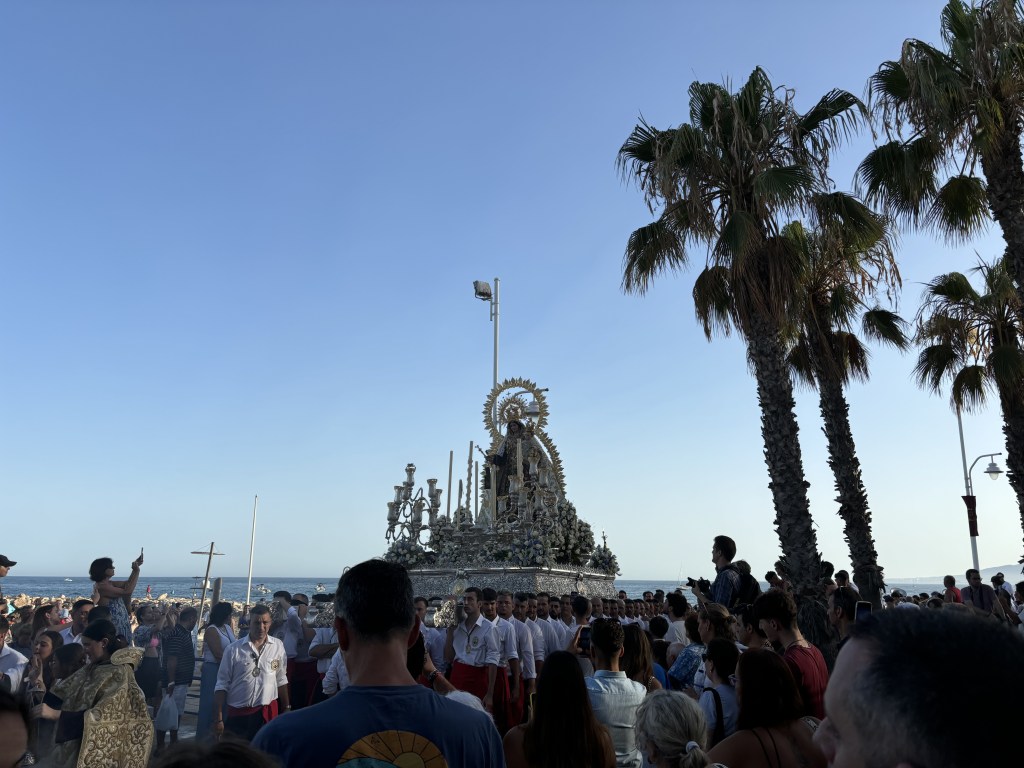
I pick up my pace when I hear the rapid tickling of bells and the crack of snare drums. My partner and I arrive just in time for the procession of the Virgen del Carmen along the boardwalk in Pedregalejo, an old fishing neighborhood in Málaga, Spain.
Every July 16th, many towns on the Costa del Sol celebrate the patron saint of sailors, Carmen, with a parade that culminates on the beach. In Málaga, the annual summertime tradition is marked with great passion and pageantry. Families and friends line the streets, sometimes waiting for up to an hour for the procession to arrive.
On this day, my friends are among the crowd expecting us. I chuckle when I see them. They’re camped outside a bar on the parade route sipping cold beers to temper the summer heat and pass the time. Genius. Suddenly the band starts up again and my eyes turn down the street. Next to me a father hoists his toddler onto his shoulders as dozens of men, women, and even children from the Corpus Christi congregation saunter toward us. Some are carrying long candles like walking sticks and others balance tall wooden oars against their shoulders. Their presence alerts us that the trono (a religious float) carried during the procession is near.
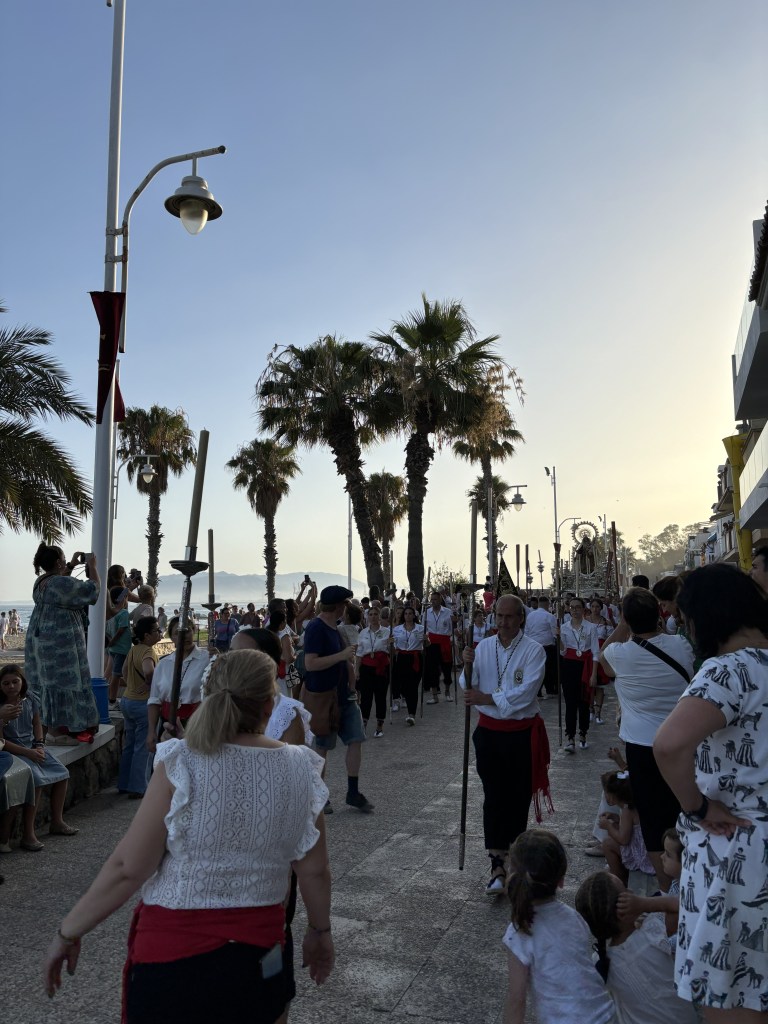
I can see it coming in the distance–a lifesize statue of a solemn woman in a burgundy and gold embroidered cloak. She seems to be gliding through the air, but it’s really the men carrying the trono marching in lockstep who control her steady forward trajectory like puppeteers. “Viva la Virgen del Carmen!” one woman from the crowd yells. “¡Viva!” others respond fervently. “¡Guapa, guapa, guapa!” shouts another.
The trono inches toward me. About 80 men are required in a procession like this. Together they bear the trono’s immense weight–sometimes more than 7,000 pounds–on their shoulders. Each of them are dressed in a typical regional costume that includes a white shirt, black pants with a red sash and espadrilles. It’s hard work carrying the trono, so about every 100 meters a bell sounds letting them know to put the trono down and rest for a few minutes.
During one of the pauses, they stop right in front of me so I can see the trono up close. The statue is adorned with a gold orb around her head, and she’s carrying a baby in the crook of her arm. She sits on top of an ornate silver platform with fresh flowers and tall white candles. The candles are lit and the flames flicker from the sea breeze, but the smell of sweet lavender incense still hangs in the air. I try to take in the sights, sounds, and smells, not wanting to miss any of it. After the break, the trono passes with the band trailing behind made up of rows of trumpet and clarinet players and finally the drummers. The music reverberates through my body and I catch myself humming along. For a religious event the mood isn’t somber, but instead celebratory.
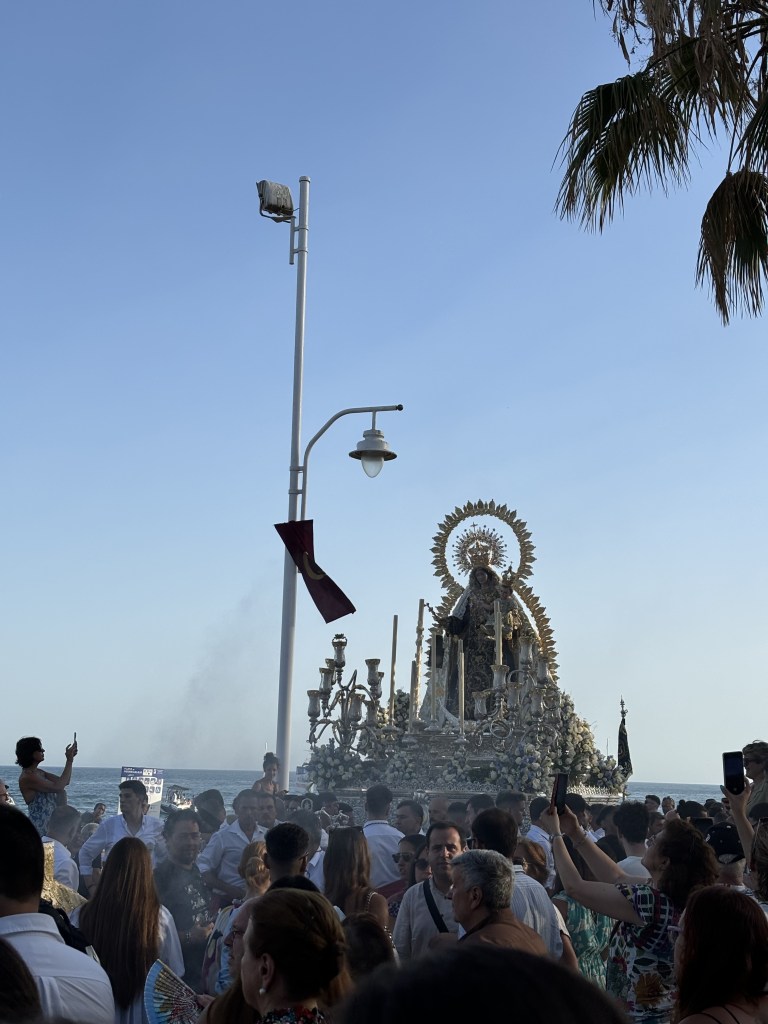
The trono’s final destination is the Pedregalejo beach, and I dutifully follow my friends to a grassy slope to witness the Virgin’s send off. It’s as close as we can get. The crowd is building both on land and water where dinghies and sailboats bob along the shore. The Virgin is lowered into a jábega (a traditional wooden fishing boat) on a trailer. Then the trailer is pushed with frightening speed through the sand. It splashes into the water and disappears under the waves. I blink and the jábega has broken free and is tossing gently on the sea. The crowd erupts with cheers and clapping.
I join in the applause, amazed the operation didn’t end in disaster with the hand-painted Virgin toppling into the water. Watching the Virgin sway back and forth in the wooden boat to the rhythm of the waves is extraordinary. Maybe it’s the incense that calmed my mind and body, but I feel like I’m in a trance, unable to take my eyes off this unusual sight. A small crew of about six men climb into the boat and pull their oars through the water until she gets smaller and smaller.
By now it’s 9pm and that means Spanish dinnertime. One of the best places to get camperos, Málaga’s version of a sub served between palm-sized circles of bread, is just a few streets up from the beach. Eager to beat the crowds, my friends and I make a beeline for it. We sit down just as the line begins to form out the door. Behind me, two middle-aged women wearing mantillas (a traditional headdress) who participated in the procession also sit down. To my right, an entire family with toddlers, grandparents, and teens coming from the procession push three tables together.
The evening’s events have all the elements of typical gatherings in Spain: tradition, family, and of course, food. More than anything, including faith, what keeps people celebrating Día del Carmen each year is the unity it fosters. By championing the Virgin Carmen, the community once again declares their love for their city by the sea. After the waiter brings our camperos, someone in the group says to me, “Well, between this and the procession today you’re already half Malagueña!”


 Halley Rogers